America is enamored with celebrities. We read magazines to keep up with their lives, follow them on Facebook, and buy products that they endorse. However, things weren’t always this way. Back in the early 1800’s, theater was considered “unholy” and was seen as a rather scandalous business. Being an actor didn’t come with the praise and frills that we see today, making it hard for thespians to make a living in the industry. However, as the 1850’s approached and plays like “Uncle Tom’s Cabin”, a play which supported Christian abolitionist teaching, the theater began to regain some of its lost reputation. This slight rise in theatrical popularity was exactly what a young Joseph Haworth needed to make his first leap into the theater industry.
Born in 1855 to Benjamin and Martha Haworth, Joseph was the oldest of the five Haworth children. By 1865, the family experienced several dramatic changes. The Civil War ended; however, Benjamin Haworth, a surveyor for the Union Army, did not live to see this new era as he died in a Confederate prison camp shortly before the cease-fire. For young Joseph, this resulted in him leaving school to provide for his family. The family moved to Cleveland, OH, where Joseph found a job working in a newspaper office. While Joseph was thankful for the position, his true passion was the theater.

Earlier in 1865, Joseph saw his very first theatrical performance, “The Count of Monte Cristo.” This experience instantly captivated Joseph, and when he moved to Cleveland he pursued several different acting opportunities. Being so young and having minimal experience, he was turned down time and time again. Haworth didn’t let his denial squelch his love of entertaining though. After a day’s work at the newspaper office, Haworth was often invited to neighbors’ homes to tell interesting stories and perform short skits. He gained local recognition as an amateur entertainer. These visits paid off, as when Haworth was 18 years old he was finally offered a position at the Academy of Music in Cleveland, which was one of the most respected theater companies in the nation at the time. The gig was minor; Haworth was only to recite a few pieces of poetry. But these few poetry readings were enough to land Haworth favorable reviews in the Cleveland Plain Dealer, and soon Haworth worked his way up to acting with several well-known stars at the time such as Fanny Januschek, Anna Dickinson, Lawrence Barrett, and Edwin Booth.
On May 10th, 1878 at just 22 years old, Haworth played the title role in “Hamlet”. His performance was praised by the Plain Dealer which said, “No young actor could have felt more pride in the appreciation of his abilities and merits than Joseph S. Haworth last evening.” Shortly after this newsworthy performance, Haworth decided to leave the Academy (now called the Euclid Avenue Opera House) and joined the Boston Museum Acting Company, which was known the be the finest acting company in the country. Haworth had a growing national presence by the time he moved to Boston, and his time there was one of great growth. He continued to land significant roles and his popularity steadily grew. Eventually, he was the offered the position as Lead Actor, but turned it down to pursue opportunities in New York City.

While in New York, Haworth met John McCullough; a well-known actor and future mentor for Haworth. The two became like father and son, McCullough always insisting that Haworth pursue artistic passions instead of commercial gains. The two acted in several productions together before McCullough passed away in 1884. Even before McCullough’s passing, Haworth had landed several solo roles, and his name appeared often in the New York Times. With his raising star power, and loss of his very close mentor, Haworth decided to move back to Cleveland to recoup in 1895. He didn’t reenter the theater scene until 1896 when he moved around the country in a series of Shakespearean plays. Towards the end of 1886, Haworth opened at the New York Grand Opera House in a performance of “Hoodman Blind.” As if Haworth wasn’t already famous, this performance heightened his fame even more, making him one of the hottest young stars in the country.
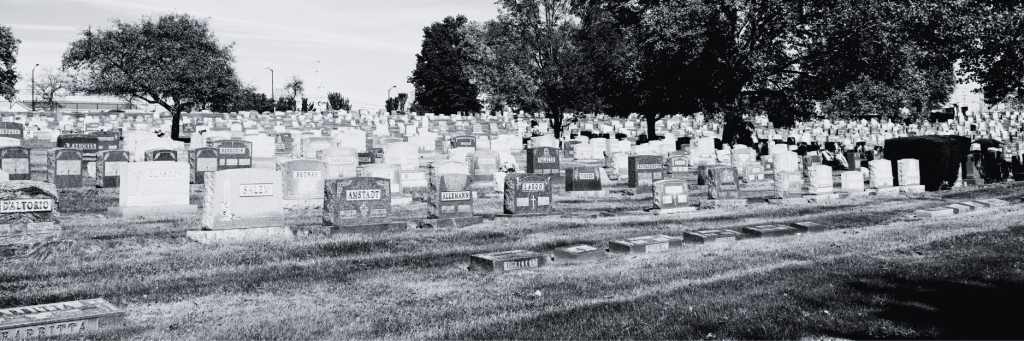
With the emergence of Broadway in the 1900’s, Haworth would continue to act for a few years before dying of congestive heart failure on April 30th, 1903. It’s speculated that this heart failure was brought on by over-exertion, something that is all too common among entertainers. Haworth is buried at St. John Cemetery, in Cleveland, OH. (Section 11, Level 3, Lot 1 PT 5)
Post written by Katie Karpinski





Leave a Reply